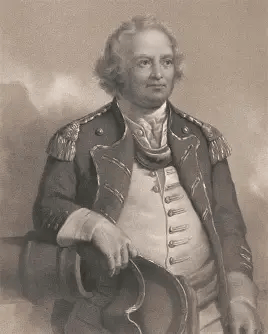
By Den Ardinger 32° KCCH
Major General Israel Putnam was a Massachusetts‑born farmer turned frontier fighter and Revolutionary War general whose bravery, colorful exploits, and uneven military record made him one of early America’s most famous, and most debated, patriot figures.
Putnam was born on January 7, 1718, in Salem Village (now Danvers), Massachusetts. He came from a prosperous Puritan farming family headed by Joseph Putnam and Elizabeth Porter where he was the tenth of eleven children. His family had opposed the Salem witch trials decades earlier, a stance that shaped their reputation in the community.
Putnam received a basic education typical of rural New England children and worked on the family farm raising sheep, goats, and oxen. In 1739, he married Hannah Pope with whom he had ten children. In 1740, at age 22, Putnam moved his family to Mortlake Manor in northeastern Connecticut (now Pomfret and Brooklyn), where land was cheaper and opportunities greater. Their marriage lasted until her death in 1765.
In 1767, he married Deborah Lothrop, a wealthy widow whose resources and social standing further elevated Putnam’s position in Connecticut society. Putnam quickly became a successful farmer, known for his fruit orchards, livestock, and strong ties to the local community. His fame grew dramatically in 1743 after he crawled into a wolf den and killed the last known wolf in Connecticut, a story that became legendary and earned him the nickname “Old Wolf Put”.
Putnam’s military career began in 1755 when he enlisted as a private in the Connecticut militia at age 37. He rose rapidly through the ranks, eventually becoming a major and later a lieutenant colonel. Serving with Rogers’ Rangers, he gained a reputation for frontier skill, courage, and leadership.
His French and Indian wartime exploits became famous including:
In 1757 he fought a fire threatening the powder magazine at Fort Edward, suffering severe burns while preventing an explosion
In 1758 he was captured by Mohawk warriors, tied to a tree, and nearly burned alive before being saved by a rainstorm and the intervention of French officer Captain Molang
He survived a shipwreck off Cuba during the 1762 British expedition against Havana
He helped construct Crown Point and participated in operations leading to the fall of Montreal in 1760
By war’s end, Putnam was widely celebrated as a frontier hero whose bravery bordered on myth.
After returning to his Connecticut farm, Putnam became active in politics. He joined the Sons of Liberty, opposed British taxation, and served two terms in the Connecticut General Assembly. During the Stamp Act crisis of 1765-66, he threatened Governor Thomas Fitch, demanding he surrender the hated tax papers. His tavern, The General Wolfe, became a local political hub.
Putnam’s transition to Revolutionary War leadership was dramatic. When he heard of the Battles of Lexington and Concord on April 19, 1775, he famously left his plow in the field and rode 100 miles to Cambridge to join the patriot forces. He was appointed a major general, one of only four under George Washington.
Putnam played a major role in the Battle of Bunker Hill, helping organize defenses on Breed’s Hill and possibly giving the famous order, “Don’t fire until you see the whites of their eyes”. Although the Americans retreated, the British suffered heavy casualties.
Putnam’s later wartime record was mixed. He commanded forces in New York during the Battle of Long Island, where his troops were outmaneuvered and forced to retreat. Washington did not blame him, but his confidence in Putnam waned. Putnam later lost Forts Montgomery and Clinton to British forces under Henry Clinton, was investigated, and ultimately exonerated.
In December 1779, Putnam suffered a paralyzing stroke that ended his military career.
Though not a master strategist, Putnam’s courage, frontier legend, and patriotic zeal made him one of early America’s most beloved folk heroes. His life embodied the rough, daring spirit of the colonial frontier and the early fight for independence.
Israel Putnam is historically recognized as a Freemason, though surviving records do not identify the specific lodge he belonged. Freemasonry during the 18th century was a widespread social and philosophical network, and many military officers participated in lodges that fostered camaraderie, moral instruction, and civic engagement. Putnam’s identification as a Freemason reflects this broader cultural context.
Based on reliable information, Israel Putnam was a confirmed Freemason, but no lodge name has been identified. Many early American Masonic records were incomplete or lost, and it is not uncommon for Revolutionary‑era figures to have known Masonic affiliations without surviving lodge documentation.
Putnam spent his final years on his Connecticut farm and died on May 29, 1790, at age 72. He is buried in Brooklyn, Connecticut, where a monument marks his resting place.
General Israel Putnam, more than a man, a Mason.

