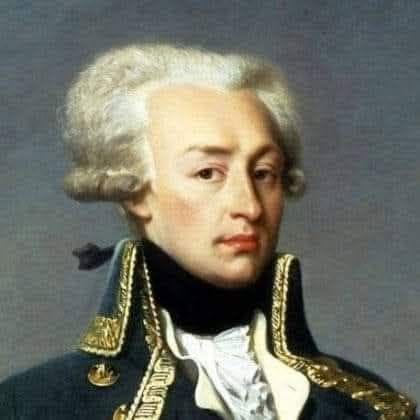
By Den Ardinger 32° KCCH
Marie-Joseph Paul Yves Roch Gilbert du Motier, Marquis de Lafayette, was a French aristocrat, soldier, and political idealist who became one of the most important European supporters of the American Revolution. Born on September 6, 1757, at the Château de Chavaniac in Auvergne, France, Lafayette came from a wealthy noble family with a long military tradition. His father was killed while serving in the Seven Years’ War when Lafayette was only two years old. Lafayette inherited his family’s considerable fortune and title at a young age, giving him the independence to pursue a military and political career.
In 1771, at the age of fourteen, Lafayette married Adrienne de Noailles, the daughter of the influential Duke of Ayen. His marriage connected him to one of France’s most powerful aristocratic families. Despite his privileged background, Lafayette developed a strong interest in the ideas of liberty and representative government that were increasingly circulating in Europe and America.
In 1777, while only nineteen years old, Lafayette traveled to North America to support the American colonies in their rebellion against Great Britain. He financed much of his own expedition and initially served without pay. His enthusiasm impressed the American leadership, particularly George Washington, with whom he developed a close personal relationship. Washington became a father-like figure to the young French officer, while Lafayette regarded Washington with enormous respect.
Lafayette received a commission as a major general in the Continental Army. Although inexperienced, he quickly earned a reputation for courage, loyalty, and determination. He fought in several important campaigns, including the Battle of Brandywine in 1777, where he was wounded. He later played an important role in the campaign in Virginia in 1781. Lafayette commanded American forces against British troops under Lord Cornwallis and helped contain Cornwallis’s army until the arrival of Washington and the French forces. The eventual British surrender at Yorktown in October, 1781, effectively ended major combat in the American Revolution.
Lafayette returned to France as a celebrated hero. He became an important advocate for political reform and constitutional government. His experiences in America strengthened his belief that liberty should be protected by law and that governments should represent their people. He maintained his friendship with Washington and remained deeply interested in the development of the United States.
Lafayette’s political ideals were also reflected in his relationship with Freemasonry. He became associated with Freemasonry during the period when Masonic lodges were important meeting places for intellectuals, military officers, and political reformers. Freemasonry emphasized principles such as fraternity, moral improvement, equality among members, and the ideal of universal brotherhood. Lafayette’s Masonic associations brought him into a network that crossed national and social boundaries. His relationship with Freemasonry was particularly significant because many prominent figures of the American Revolution were Freemasons, including George Washington.
During the French Revolution, Lafayette attempted to apply the principles of liberty and constitutional government to France. In 1789, he became commander of the Paris National Guard and supported the creation of a constitutional monarchy. He was closely associated with the Declaration of the Rights of Man and of the Citizen, a foundational document of the French Revolution. Lafayette’s political position became increasingly difficult as the Revolution grew more radical. He opposed political violence and the rise of revolutionary extremism.
When the monarchy collapsed, Lafayette’s moderate position made him unpopular with the radical revolutionaries. He eventually fled France but was captured by Austrian forces and imprisoned for several years. He was released in 1797 after diplomatic pressure but remained politically marginalized during Napoleon’s rule.
After Napoleon’s fall, Lafayette returned to political life. In 1824, he made a famous tour of the United States, visiting numerous states and receiving enormous public celebrations. Americans remembered him as a young Frenchman who had risked his fortune and life for their independence. He was welcomed as a living hero of the Revolution.
Lafayette died in Paris on May 20, 1834, at the age of seventy-six. He was buried at Picpus Cemetery, where American soil was placed over his grave as a lasting symbol of his connection to the United States.
The Marquis de Lafayette’s legacy rests on his extraordinary international career. Lafayette’s relationship with Freemasonry was an important part of his international network of friendships and political associations, particularly his connections between France and the United States. He was unquestionably a Freemason, although it has not been established where he received his degrees although it was before he sailed to America in 1777.
The strongest early evidence concerns Lodge Saint-Jean de la Candeur (La Candeur) in Paris. A surviving program for the lodge’s inauguration in December 1775 lists Lafayette among the visiting brethren. The document is particularly significant because it identifies him as a Mason before his departure for America. This establishes that Lafayette was participating in Masonic circles by 1775, although it does not prove that La Candeur was the lodge in which he was initiated. Masonic historians have also proposed Loge du Contrat Social in Paris as a possible lodge where he received his degrees.
Once in America, Lafayette’s Masonic relationships developed alongside his military and political career. His close friendship with George Washington became one of the most famous personal relationships of the American Revolution. Both men were Freemasons, and their shared Masonic affiliation became an important part of how later generations remembered their friendship.
Lafayette’s Masonic connections became especially visible during his celebrated 1824–1825 tour of the United States. By then, he was not merely a famous Revolutionary War veteran but a revered symbol of the Franco-American alliance. Masonic lodges throughout the country welcomed him with ceremonies, dinners, processions, and other honors. In New York City, the Grand Lodge of New York hosted a magnificent Masonic banquet for Lafayette in October 1824. Numerous lodges participated, including St. John’s, St. Andrew’s, Hiram, Holland, Trinity, Washington, La Sincerite, and La Fayette Lodge. The event demonstrated the extraordinary esteem in which American Freemasons held him.
On September 12, 1824, Lafayette became a member of Jerusalem Chapter No. 8 in New York City, thereby becoming a Royal Arch Mason. He subsequently became associated with the Knights Templar, including Morton Commandery No. 4 and Columbian Commandery No. 1 in New York. He also received Scottish Rite degrees through the Cerneau Supreme Council in New York and was honored as a 33rd-degree Mason and Honorary Grand Commander. These honors illustrate how American Freemasonry embraced Lafayette as a living symbol of the Revolutionary generation and of the fraternity’s international ideals.
One of the most memorable episodes of Lafayette’s Masonic tour occurred at Apollo King Solomon’s Lodge No. 13 in Troy, New York. During his visit, Lafayette presented his personal hand-painted Masonic apron to the lodge’s Master, Worshipful Brother Adna Treat. The apron became a tangible reminder of Lafayette’s connection to American Freemasonry and of the fraternity’s admiration for the French officer who had fought alongside American revolutionaries.
Lafayette’s Masonic reception extended beyond New York. In Lexington, Kentucky, local Freemasons honored him with a large dinner and ball on May 16, 1825, at the Grand Masonic Hall. Approximately 800 guests attended, and the decorations prominently featured Lafayette alongside other heroes of the American Revolution.
The significance of Lafayette’s Freemasonry should therefore be understood in the context of his broader commitment to international friendship and constitutional liberty. Freemasonry gave Lafayette relationships that crossed national, religious, political, and social boundaries, while his revolutionary career gave American Freemasons an exceptionally powerful symbol of fraternity between France and the United States. Although it would be inaccurate to claim that Freemasonry alone shaped Lafayette’s political philosophy, the fraternity provided an important social and intellectual network that reinforced his lifelong identification with liberty, friendship, and international cooperation.
The Marquis de Lafayette, more than a man, a Mason.

