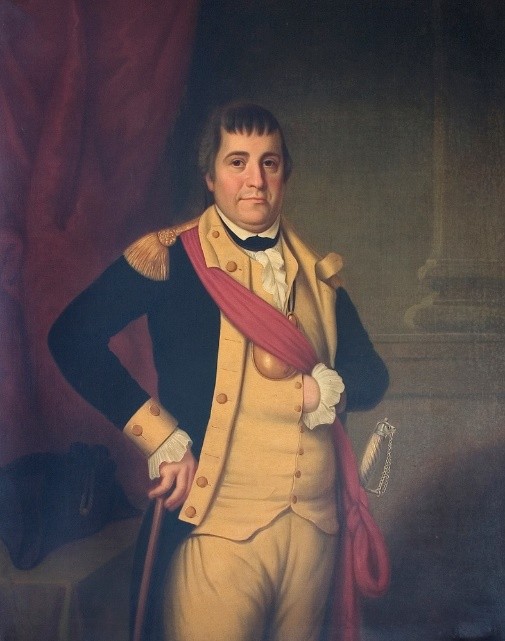
By Den Ardinger 32° KCCH
William Barton (1748-1831) was one of Rhode Island’s most celebrated Revolutionary War officers, remembered above all for the bold nighttime raid in 1777 that captured British Major General Richard Prescott.
William was born May 26, 1748, in Warren, Rhode Island, the son of Benjamin and Lydia Brown Barton. He received a common-school education, and in early adulthood learned the trade of hat-making. Like many ambitious artisans in colonial New England, he moved from his birthplace to Providence, where he established himself in business and entered public life. Before the American Revolution fully transformed him into a soldier, he was known simply as a working tradesman with a growing family and local standing.
On April 26, 1771, Barton married Rhoda Carver. They had ten children with eight surviving to adulthood. When fighting in the American Revolution began four years later in 1775, he entered military service. He joined Rhode Island forces as a corporal and saw his first combat at Bunker Hill but rapidly rose through the militia to the rank of major. He was energetic, daring, and unusually capable, especially with complex operations involving intense timing. He served with Rhode Island forces at a moment when Narragansett Bay and Newport were central to the struggle between British and American power in the region. By 1777, he had risen high enough in command to conceive and lead the exploit that made his reputation throughout the new nation on the night of July 9-10, 1777.
Learning that General Richard Prescott, commander of British forces on Aquidneck Island, was lodged in a farmhouse near Newport, Barton organized a hand-picked party of about forty men and quietly crossed Narragansett Bay in whaleboats under cover of darkness. Silently slipping past British warships, the raiders landed, rushed the house, overcame the guards, and seized Prescott before he could mount a defense. Prescott was carried away half-dressed and taken safely back across the bay. The feat electrified American opinion because it reversed, in one daring stroke, the humiliation Rhode Islanders had felt for years under British occupation. Congress honored Barton with a ceremonial sword, and his exploit helped make possible Prescott’s exchange for the captured American General Charles Lee.
Barton was promoted in 1777, becoming a lieutenant colonel and then colonel. In 1778 he was severely wounded in the thigh, and he never fully recovered. Even so, he returned to service in 1779 to command light infantry operating by boat in Narragansett Bay, a role suited to his aggressiveness and knowledge of local waters. After the war he remained active in public affairs. He supported the adoption of the federal Constitution in 1787 and was among the Rhode Islanders who helped bring the previously reluctant state into the Union. He was the officer chosen to inform President George Washington of Rhode Island’s ratification.
Sadly, his later years were marked by misfortune. Barton became entangled in a land dispute in Vermont, in connection with the town of Barton, which he had helped found. He refused, on principle, to satisfy a judgment against him, and because of this he spent roughly thirteen years confined there as a debtor. His old comrade, the Marquis de Lafayette, learned of Barton’s condition during his American tour in 1824-25 and paid the remaining debt, allowing the aging veteran to return home to Providence. Barton died there on October 22, 1831, at age eighty-three, and was buried in the North Burial Ground.
Barton’s ties to Freemasonry form an important part of his civic identity. He was a member of St. John’s Lodge in Providence, Rhode Island, and Rhode Island Masonic historical material specifically notes that the capture of British General Prescott was carried out by “Col. William Barton,” a member of that lodge.
William Barton was more than a daring partisan officer: he was a Rhode Island artisan, family man, Revolutionary hero, and constitutional advocate, whose life joined military audacity with civic fraternity.
William Barton, more than a man, a Mason.

