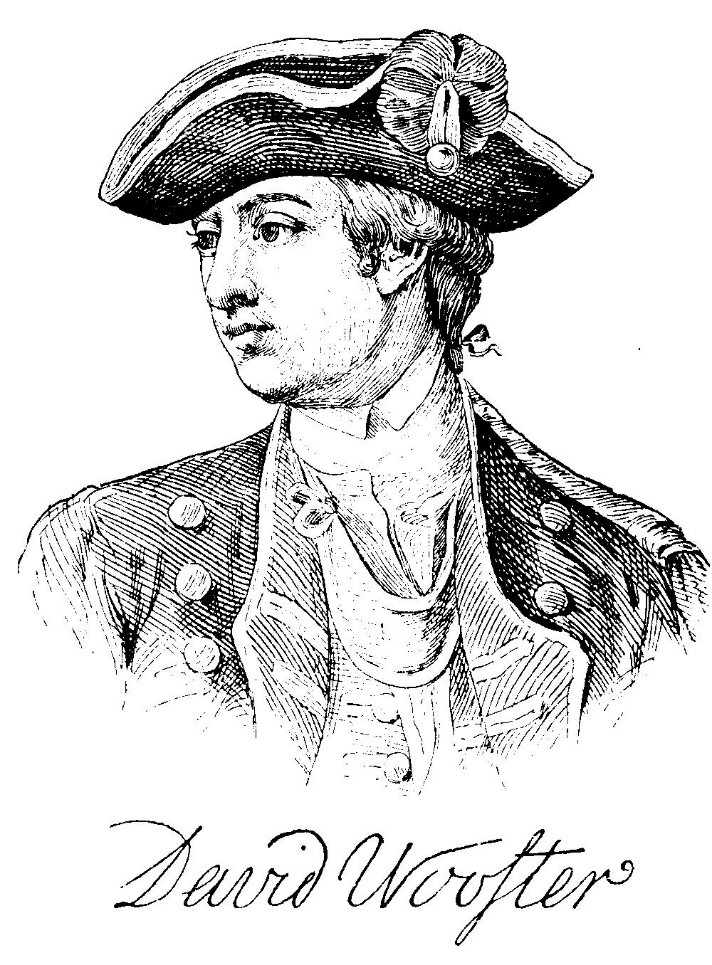
By Den Ardinger 32° KCCH
General David Wooster (1710–1777) was a prominent American military officer, patriot leader, and early supporter of independence during the American Revolutionary War. Born on March 2, 1710, in Stratford, Connecticut, Wooster grew up in a well-established colonial family. His father, Samuel Wooster, was a respected local official, and his mother, Mary Wooster, came from another influential New England family. This background provided young David with both educational opportunities and exposure to civic responsibility from an early age.
Wooster graduated from Yale College in 1738, an institution that would later play a significant role in his legacy. After completing his studies, he pursued a military career, gaining early experience during the War of Jenkins’ Ear and later in King George’s War. During these conflicts, Wooster demonstrated leadership and courage, rising in rank and earning a reputation as a capable officer.
In 1745, Wooster participated in the successful British colonial expedition against the French fortress at Louisbourg on Cape Breton Island. His service there further enhanced his standing, and he later spent time as a prisoner of war in France after being captured at sea. While in Europe, he reportedly gained a broader perspective on international politics and military organization, experiences that would inform his later leadership.
Wooster married Mary Clap Wooster, the daughter of Thomas Clap. This marriage connected him to one of Connecticut’s most influential academic and religious families. Together, David and Mary had several children, though, as was common in the 18th century, not all survived to adulthood. His family life was closely intertwined with his public service, and his social standing helped reinforce his leadership role within Connecticut society.
As tensions between the American colonies and Great Britain escalated in the 1770s, Wooster emerged as a strong advocate for colonial rights. He became active in local governance and resistance efforts, aligning himself with the Patriot cause. When the Revolutionary War broke out in 1775 following the Battles of Lexington and Concord, Wooster was appointed as a brigadier general in the Connecticut militia.
Soon thereafter, he was commissioned as a general in the Continental Army, serving under George Washington. Wooster took part in the American invasion of Canada; a campaign aimed at bringing the northern British colonies into the revolutionary fold. He served as military governor of Montreal in 1775–1776. However, his administration was controversial; some contemporaries criticized him for what they viewed as heavy-handed policies and ineffective leadership during a difficult occupation.
After the American withdrawal from Canada, Wooster returned to Connecticut, where he resumed command responsibilities. In April 1777, British forces under William Tryon launched a raid on the American supply depot at Danbury, Connecticut. Despite being in his late sixties, Wooster took to the field to oppose the British advance. He led militia forces in a series of engagements intended to harass and slow the enemy’s retreat.
On April 27, 1777, during the Battle of Ridgefield, Wooster courageously attacked the rear guard of the British column. During this engagement, he was mortally wounded by musket fire. He was transported to nearby Danbury, where he died several days later on May 2, 1777. His death was widely mourned, and he was remembered as a brave and dedicated patriot who gave his life for the cause of independence.
In addition to his military and civic contributions, David Wooster had ties to Freemasonry, a fraternal network that included many prominent figures of the Revolutionary era. While definitive documentation of his lodge membership is limited, historical accounts and traditions support he was associated with Masonic circles in New Haven, Connecticut, particularly with Hiram Lodge No. 1 in 1750 where the tradition believes he was the Worshipful Master. This Lodge has long held connections to Yale and Wooster’s familial connection through Yale and his social standing would have made such affiliations likely, as Freemasonry was particularly influential among colonial leaders, emphasizing Enlightenment ideals such as liberty, equality, and moral virtue.
Wooster’s legacy endures in Connecticut and beyond. He is buried in Wooster Cemetery, and his name has been commemorated in towns, streets, and institutions, including Wooster Square in New Haven. His life reflects the character of many early American patriots: rooted in community, shaped by imperial conflict, and ultimately committed to the struggle for independence. Though not as widely known as some of his contemporaries, David Wooster played a vital role in the Revolutionary War and remains a respected figure in American history.

