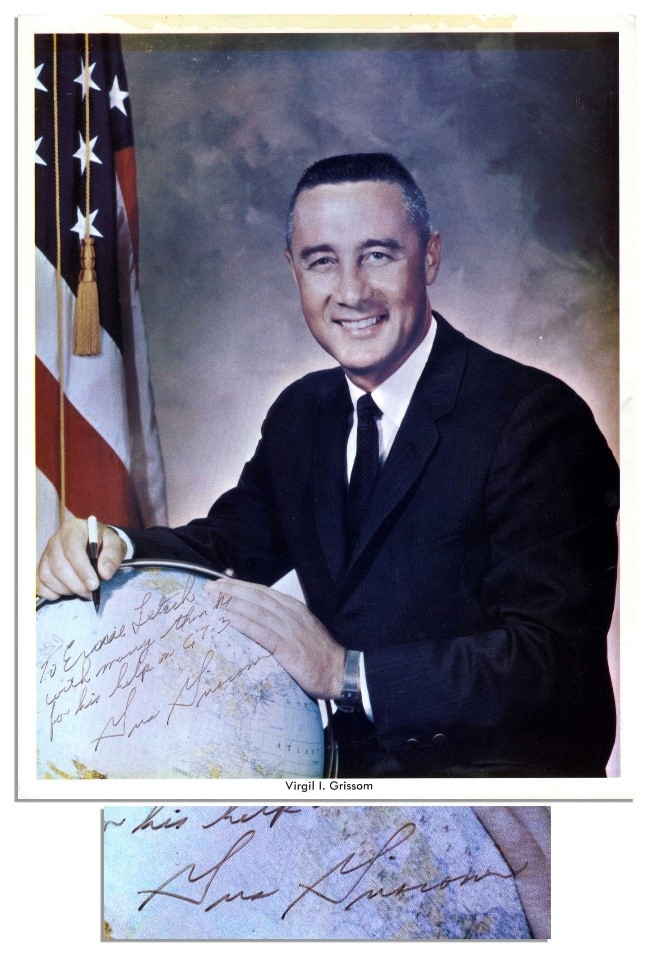
By Den Ardinger 32° KCCH
Virgil Ivan “Gus” Grissom was born in Mitchell, Indiana on April 3, 1926. He was the son of Dennis David Grissom and his wife, Cecile King. In grade school he was given the nickname “Gus”, and he kept it all his life. He was active in sports but was only an average student other than in mathematics. He had an early interest in aviation and a local attorney took him on short flights in his personal aircraft and taught Gus the basics of flying.
During his senior year in high school, he enlisted as an aviation cadet in the U. S. Army Air Forces. After graduating in 1944, he entered active duty on August 8th at Fort Benjamin Harrison in Indiana. He was sent to Sheppard Field in Texas for five weeks of basic flight training and then to Boca Raton Army Airfield in Florida. While home on leave in August 1945, he married his high school sweetheart, Betty Lavonne Moore (1927-2018). He was discharged in November 1945 after World War II ended. Using the G.I. Bill, he enrolled at Purdue University in September 1946. He graduated with a Bachelor of Science degree in Mechanical Engineering in February 1950. His son, Scott, was born at this time.
Gus became a Mason in his hometown through Mitchell Lodge 228. He was initiated February 10, 1949. He was passed to Fellowcraft on April 14th and raised a Master Mason on May 19, 1949. He later became a member of our very own Scottish Rite, Valley of Orlando, on September 25, 1963. In addition to other Masonic organizations, he was a member of York Rite and Bahia Shrine here in Orlando in 1963.
After graduating from college, he enlisted in the United States Air Force and was commissioned a second lieutenant, completed pilot training, and was award his pilot’s wings in March 1951. He was then assigned to Presque Isle, Maine and the 75th Fighter-Interceptor Squadron. With the Korean War going on, he deployed to Korea and flew 100 combat missions with F-86 Sabre jets with the 334th Fighter Squadron out of Kimpo Air Base where he was awarded the Distinguished Flying Cross and Air Medal with oak leaf cluster. He then returned to the U.S. and became a flight instructor at Bryan Air Force Base in Texas. His second son, Mark, was born in 1953.
In August 1955 he was assigned to the Air Force Institute of Technology and earned a Bachelor of Science degree in aeromechanics in 1956. After completion he entered Test Pilot School at Edwards Air Force Base in California. From here he was assigned to Wright-Patterson Air Force Base in Dayton, Ohio.
After intense competition with 508 other highly qualified candidates, Gus was officially notified on April 13, 1959, that he was one of seven test pilots selected for the Project Mercury program that would introduce the United States into space. On July 21, 1961, he was the pilot of the second flight of the Mercury-Redstone 4 launched from Cape Canavaral, Florida. He named his craft Liberty Bell 7 for its suborbital fifteen-minute flight. Upon landing in the ocean, however, the emergency explosive bolts fired causing the capsule to flood. Recovery helicopters from the USS Randolph tried saving the capsule before it became too heavy from flooding, but the lines had to be cut and the capsule sank as Gus swam to safety with his suit rapidly filling with water. The exact reason for why the explosive bolts fired has never been determined but NASA concluded that Gus had not necessarily fired the hatch bolts himself. Possible reasons were speculated on for thirty years after the flight with most suspecting that a static discharge had blown the explosive bolts before the helicopters were in place during the recovery effort.
In 1962, Florida Institute of Technology awarded him an honorary doctorate degree…the first ever awarded by the school.
Gus stayed with the NASA program and became part of Project Gemini. In 1964 he was named as the command pilot for the Gemini 3 mission. This was the first mission with two astronauts onboard. On March 23, 1965, the mission was successfully flown, making him the first astronaut to fly into space twice. He made three orbits of the Earth with fellow astronaut John Young. The mission lasted just short of five hours.
He was the backup pilot for Gemini 6A when he was transferred to the Apollo Program as commander of the first crewed mission named Apollo 1 along with senior pilot Ed White and pilot Roger Chaffee. It was widely believed that the program was being pushed too quickly and that the Apollo design had many defects. Pushing the schedule on January 27, 1967, a fire in the cockpit during a pre-launch test on Launch Pad 34, ended the life of all three men when a spark ignited material in the oxygen rich environment with no way to extinguish it.
The funeral services were held at Arlington National Cemetery on January 31, 1967, with President Lyndon Johnson and other dignitaries present. Lieutenant Colonel Gus Grissom is buried next to Roger Chaffee and Ed White is buried at the U. S. Military Academy at West Point.
Gus Grisson’s honors are many including the NASA Distinguished Service Medal being awarded twice. The AIAA Haley Astronautics Award was posthumously awarded in 1968. His family was awarded the Congressional Space Medal of Honor in 1978. Statues, buildings, an airport and an Air Force Base have been named for him. Apollo 15 astronauts left the Fallen Astronaut statue on the Moon in 1971. He was inducted into the International Space Hall of Fame in 1981, the National Aviation Hall of Fame in 1987 and the U. S. Astronaut Hall of Fame in 1990. His hometown of Mitchell, Indiana has a 44-foot Grissom Memorial in the downtown area and the Gus Grissom Stakes horse race is held in the fall each year in Indiana. Gus Grissom, more than a man, a Scottish Rite Valley of Orlando Scottish Rite Mason.
 Valley of Orlando eNews