By Den Ardinger 32° KCCH
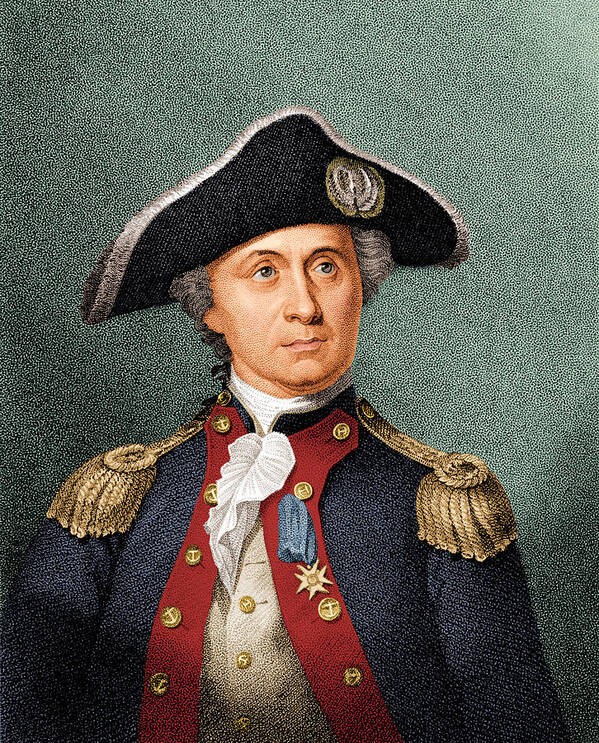
Admiral John Paul Jones (1747–1792) is remembered as one of the most daring naval commanders of the American Revolution and is often called the “Father of the American Navy.” His bold leadership, relentless fighting spirit, and famous declaration, “I have not yet begun to fight!” made him a legendary figure in early American naval history. Born in Scotland and rising to prominence in the service of the young United States, Jones lived a life filled with adventure, controversy, and international recognition.
Early Life and Family
John Paul Jones was born John Paul on July 6, 1747, at Arbigland near Kirkbean in Kirkcudbrightshire, Scotland. His father, John Paul Sr., was a gardener employed by the Arbigland estate, and his mother, Jean McDuff, came from a respectable Scottish family. The couple raised several children, and young John grew up in modest circumstances but with access to education and maritime influences along the nearby Solway Firth.
From an early age, he was fascinated by the sea. At just 13 years old, he began an apprenticeship aboard a merchant ship and quickly developed skill and discipline as a sailor. During his youth he worked on trading vessels engaged in transatlantic commerce, including voyages to the American colonies and the Caribbean.
After the deaths of both his brother and the owner of the vessel he commanded in the West Indies, Paul inherited some property in Virginia and eventually adopted the additional surname “Jones.” Historians are uncertain why he added the name, but it likely helped him distance himself from earlier legal difficulties in the Caribbean involving the death of a mutinous sailor. By the early 1770s he had settled for a time in Virginia, where he would soon become involved in the American cause.
Service in the American Revolution
When the American colonies rebelled against British rule in 1775, Jones volunteered his services to the new Continental forces. He received a commission as a lieutenant in the Continental Navy, the naval arm created by the Continental Congress.
Jones first served aboard the frigate USS Alfred, where he is often credited with helping raise the first American naval flag aboard a warship in 1775. His bravery and seamanship quickly became evident, and he was given command of several vessels during the war.
His most famous command came aboard the warship Bonhomme Richard. On September 23, 1779, Jones engaged the powerful British ship HMS Serapis off the coast of England. During the fierce battle, the British captain asked whether Jones intended to surrender. Jones reportedly replied with the immortal words, “I have not yet begun to fight!”
Although Bonhomme Richard was badly damaged and eventually sank, Jones and his crew succeeded in capturing Serapis. The victory electrified supporters of the American cause across Europe and demonstrated that the young nation could challenge British naval power.
International Recognition and Later Career
Jones became a hero in France, where he had strong support from the French government, an ally of the United States during the Revolution. After the war ended in 1783, he continued seeking naval employment but found limited opportunities in the new American navy, which had largely been disbanded.
In 1788 he accepted a commission in the service of Catherine the Great, joining the Russian navy during its war with the Ottoman Empire. Although he demonstrated skill and courage, political intrigue and rivalries among Russian officers soon forced him out of the service.
Jones eventually retired to Paris, where he lived his final years.
Connection with Freemasonry
Like many military leaders of the eighteenth century, John Paul Jones had associations with Freemasonry. Historical records indicate that he was initiated into St. Bernard’s Kilwinning Lodge No. 122 in Kirkcudbright, St. Mary’s Island, Scotland, on November 17, 1770, before the American Revolution began. He received his Fellowcraft and Master Mason Degrees in the Royal White Heart Lodge in Halifax, North Carolina.
Freemasonry emphasized brotherhood, moral virtue, and Enlightenment ideals; values that appealed to many revolutionary leaders. While Jones’s Masonic involvement does not appear to have been extensive during the war, his membership placed him within a network of influential men across Europe and America. Such connections often facilitated introductions, patronage, and diplomatic relationships, especially in cities like Paris where many American diplomats and military officers interacted with Masonic circles.
Death and Legacy
John Paul Jones never married and died in Paris on July 18, 1792, at the age of 45. For more than a century his grave remained largely forgotten until American diplomats rediscovered his remains in 1905. They were returned to the United States with great ceremony.
Today Jones rests in a magnificent crypt beneath the chapel of the United States Naval Academy in Annapolis, Maryland, where he is honored as one of the founders of American naval tradition.
Historical Importance
John Paul Jones’s daring tactics, aggressive leadership, and refusal to surrender helped establish a tradition of courage and determination within the United States Navy. His exploits during the American Revolution demonstrated that the fledgling nation could challenge even the most powerful navy in the world.
More than two centuries after his death, Jones remains a symbol of naval bravery, international adventure, and the spirit of American independence. His life, from humble Scottish origins to celebrated revolutionary admiral, continues to inspire sailors and historians to this day.
Admiral John Paul Jones, more than a man, a Mason
 Valley of Orlando eNews