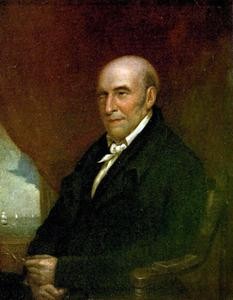
By Den Ardinger 32° KCCH
Stephen Girard (1750–1831) stands as one of the most influential financiers and philanthropists in early American history. A French-born immigrant who rose from modest beginnings, Girard became one of the wealthiest men in the United States and played a critical role in sustaining the nation during both the American Revolution and the War of 1812. His life reflects a blend of personal discipline, commercial genius, patriotic commitment, and Masonic ideals of charity and civic responsibility.
Girard was born on May 20, 1750, in Bordeaux, France, the son of Pierre Girard, a merchant sailor and small trader, and Marie Lafargue Girard. His mother died when he was young, and Girard’s formal education was limited, in part due to a severe injury to his right eye that left him partially blind and affected his social standing. Despite these disadvantages, he went to sea as a teenager, apprenticing as a sailor and learning the mechanics of international trade, navigation, and commerce.
In 1776, amid growing unrest in the American colonies, Girard arrived in Philadelphia, which soon became his permanent home. He began modestly as a merchant and ship owner, trading in commodities such as sugar, coffee, wine, and manufactured goods. Girard’s keen understanding of maritime trade, combined with an exceptional work ethic and frugality, allowed him to expand rapidly. By the 1790s, he had become one of the most successful merchants in the country.
Girard’s aid to the American Revolution was substantial, though often understated. While not a soldier, he used his ships, credit, and personal fortune to support the Continental cause. Girard traded with the French West Indies and helped bring vital supplies into American ports during the war, frequently operating under dangerous conditions. His willingness to extend credit and absorb risk helped stabilize supply lines when the fledgling nation lacked both capital and international standing. After independence, Girard continued to support the new republic financially, believing that American stability was essential to his adopted homeland’s future.
His greatest patriotic contribution came later, during the War of 1812. When the U.S. government faced financial collapse and private banks refused to fund the war effort, Girard stepped in decisively. In 1813, he purchased the majority of a critical federal war loan, effectively underwriting the government at a moment of national crisis. He also took over the operations of the defunct First Bank of the United States, running it with his own capital and providing essential liquidity to the Treasury. President James Madison later acknowledged that Girard’s actions were instrumental in preventing financial disaster.
Girard’s personal life was marked by discipline and tragedy. In 1777, he married Marie Louise Amélie Franks, the daughter of a Philadelphia merchant. The marriage proved unhappy; Marie suffered from severe mental illness and was institutionalized in 1790, where she remained until her death in 1815. The couple had one son, Jean Marie Girard, who died in childhood during a yellow fever epidemic. Girard never remarried and lived a largely solitary life, devoting himself to business and philanthropy.
His connection to Freemasonry reflects his moral outlook and civic values. Girard was initiated into Masonry in France, probably Bordeaux, and later affiliated with Masonic lodges in the United States, including membership associated with the Grand Lodge of Pennsylvania in Philadelphia. While he was not a prominent public Masonic officer, Girard embraced the fraternity’s emphasis on reason, self-improvement, charity, and service to humanity. These principles strongly shaped his worldview and philanthropic legacy.
That legacy was sealed in his will, one of the most famous in American history. Girard left the vast majority of his fortune—worth tens of millions in modern terms—to charitable causes. Most notably, he endowed Girard College in Philadelphia, an institution dedicated to educating orphaned and disadvantaged boys. He also left funds to the City of Philadelphia, the Commonwealth of Pennsylvania, and numerous public institutions, emphasizing education, public health, and civic improvement.
Stephen Girard died on December 26, 1831, at the age of 81. He is buried today in a marble sarcophagus beneath the chapel at Girard’s College in Philadelphia. Though often described as austere and reserved, his life demonstrates a profound commitment to the American experiment. Through financial courage, patriotic action, Masonic principles, and enduring philanthropy, Girard helped secure the nation’s survival and shape its moral and civic foundations for generations to come.
Stephen Girard, more than a man, a Mason.
 Valley of Orlando eNews