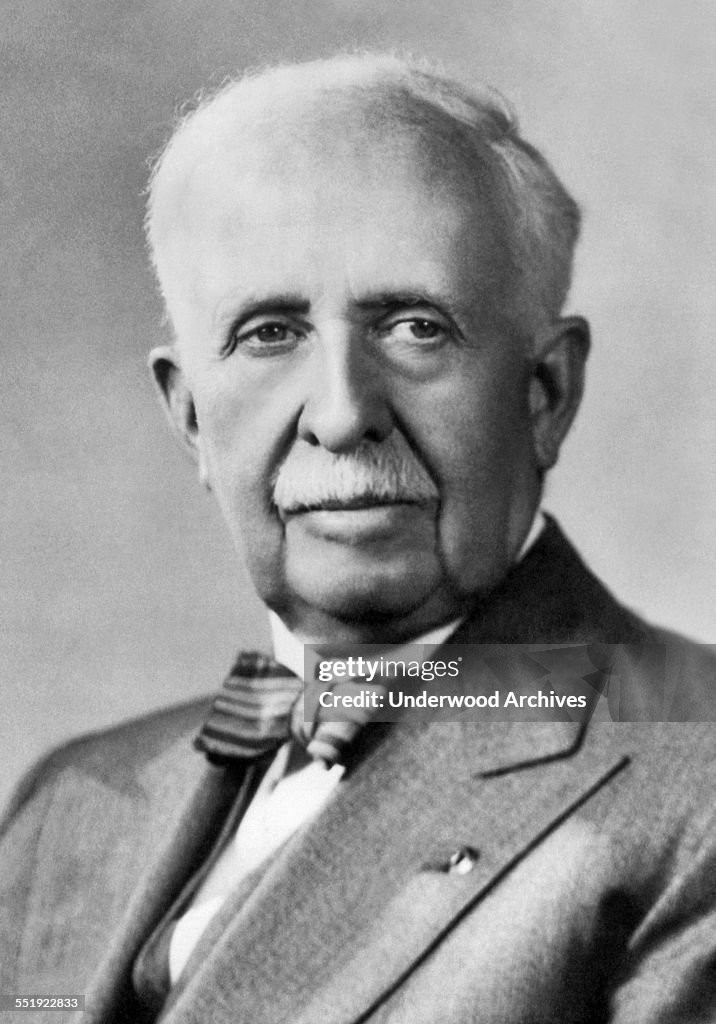
By Den Ardinger 32° KCCH
James Cash Penney, best known as the founder of the J. C. Penney retail chain, was born on September 16, 1875, in the small town of Hamilton, Missouri. He grew up in a humble household shaped by strong moral values, personal discipline, and a belief in hard work. His father, James Cash Penney Sr., was a Baptist minister and farmer whose strict but principled leadership played a central role in shaping the young Penney’s character. His mother, Mary Frances Paxton Penney, was a devoted homemaker who instilled in her children the importance of thrift, honesty, and self-reliance. Together, the Penney parents raised a large family, and James was one of several children who learned early the necessities of contributing to the household economy.
Because the family had limited financial resources, Penney’s upbringing included a great deal of responsibility at a young age. His father, determined that James should understand the value of independence, required him to purchase his own clothing once he became a teenager. This expectation served as an early motivation for him to seek employment, and he began working in local stores during his youth. These early experiences in retail laid the foundation for what would become one of the most influential careers in American business history.
After completing high school, Penney initially considered becoming a lawyer, but financial constraints and the need to support himself led him back to retail employment. He first worked in a dry-goods store in Hamilton before seeking opportunities farther west to improve his prospects. In 1898 he moved to Colorado, hoping the climate would help alleviate a chronic health condition. There he found work with the Golden Rule Stores, a small but growing chain of dry-goods shops built on strict ethical principles, including treating customers with fairness, maintaining low prices, and operating with integrity.
Penney’s talent, work ethic, and commitment to the Golden Rule philosophy quickly made him stand out. In 1902, at the age of 27, he was given the opportunity to open and co-own his own Golden Rule store in Kemmerer, Wyoming, using his savings and a loan from his business partners. The venture prospered, and Penney soon acquired additional stores. By 1913 he incorporated his expanding chain under the name J. C. Penney Company, marking the beginning of what would become a nationwide retail empire. His focus on value, customer service, and treating employees ethically played a central role in the company’s rapid growth throughout the early twentieth century.
Penney married three times during his life. His first marriage, to Bertha Hess in 1899, ended tragically when she died of pneumonia in 1910. He later married Mary Hortense Kimball in 1919, with whom he had two sons; Mary herself died in 1923 from complications in pregnancy. Penney’s third marriage was to Caroline Autenrieth in 1926, and together they raised a blended family, including two more children. Caroline died in 1992. Despite the demands of his career, Penney remained deeply devoted to his family, continuing to emphasize the same principles of thrift, service, and faith that had defined his own upbringing.
An important dimension of Penney’s life, one frequently noted in historical accounts, was his connection to Freemasonry. Penney became a Freemason early in his adulthood and remained active throughout his life. He was initiated, passed, and raised in Wasatch Lodge No. 1 in Salt Lake City, Utah. His Masonic involvement extended into the Scottish Rite, and he eventually attained high honors as a 33rd Degree Inspector General Honorary while being recognized for his philanthropic and ethical contributions. The values of Freemasonry—charity, integrity, personal improvement, and brotherhood—closely aligned with Penney’s own beliefs and were reflected in the way he conducted his business. His emphasis on the “Golden Rule,” which guided both his personal life and his retail philosophy, harmonized with the Masonic ideals of moral conduct and service to humanity.
Despite achieving immense success, Penney experienced financial hardship during the Great Depression, when he personally backed many company loans and suffered large losses. The stress took a profound emotional toll on him. Nevertheless, he recovered his footing and remained actively involved in his company for many years afterward. In his later life he devoted much of his time to charity, education, and civic leadership.
James Cash Penney died on February 12, 1971, leaving behind a legacy defined not only by one of America’s most iconic retail chains but also by a lifelong commitment to ethical business, community service, and the principles he learned in childhood and deepened through his Masonic associations.
J C Penney, more than a man, a 33rd Degree Scottish Rite Mason.
 Valley of Orlando eNews