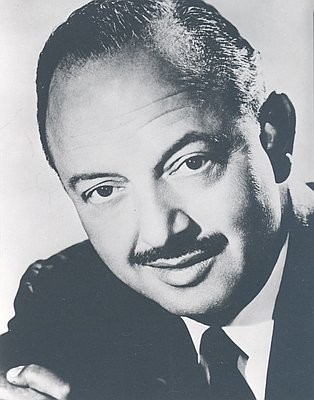
By Den Ardinger 32° KCCH
Mel Blanc, affectionately dubbed “The Man of a Thousand Voices,” was born Melvin Jerome Blank on May 30, 1908, in San Francisco, California. He was the son of Frederick Harvey Blank and his wife, Eva H. Katz. His father hailed from a German-Jewish family and his mother was of Russian-Jewish descent. Mel was the younger of two children and grew up first in San Francisco’s Western Addition neighborhood, before his family relocated to Portland, Oregon.
From a young age Mel showed a remarkable facility for sounds and voices. By around age ten he was already experimenting with accents and voice effects among friends. While attending Lincoln High School in Portland, he recalled a teacher telling him he would “amount to nothing, Just like his name, Blank,” which reportedly spurred him to change the spelling of his surname to “Blanc” at age 16.
His parents, managing a clothing business, supported his early musical endeavors though he gravitated strongly towards voice work and performance. After finishing high school in 1927, Mel embarked on his entertainment career, becoming at age 19 one of the youngest orchestra conductors in the U.S., and simultaneously performing in vaudeville shows around the Pacific Northwest. He made his first professional radio appearance in the same year on KGW’s program The Hoot Owls, showcasing his talent for creating distinct character voices. Soon he moved into Los Angeles radio, then into animated cartoons, most prominently with Warner Bros. / Merrie Melodies and Looney Tunes, voicing characters like Bugs Bunny, Daffy Duck, Porky Pig, Tweety Bird and many more.
In 1933 Mel married Estelle Rosenbaum and they had one son, Noel Blanc. Noel later joined his father’s production work and carried on voice-acting duties after Mel’s passing.
Beyond voice-acting, Blanc’s life was marked by deep commitments to fraternal and youth organizations. As a teenager he joined DeMolay International in Portland, a Masonic-rooted organization aimed at mentoring young men. According to his own testimony, he credited DeMolay with helping him become “kind and thoughtful to my parents and all my friends.”
Later, as an adult, he became a member of the Masonic fraternity at Mid Day Lodge No. 188 F.&A.M. in Portland, Oregon, where he held membership for decades. He further joined the Scottish Rite, Valley of Los Angeles, and the Shriner fraternity via the Al Malaikah Shrine Temple. His charitable work with the Shrine’s hospital system, particularly hospitals for children, was a major part of his philanthropic commitments.
Blanc’s body of work spanned radio, film and television. His unique ability to deliver multiple voices, often in the same scene, set him apart. He regularly appeared on radio shows such as The Jack Benny Program, providing a remarkable range of characters and comedic timing. In animation he became the primary voice for a host of characters at Warner Brothers and later worked for studios like Hanna‑Barbera (e.g., the role of Barney Rubble) among others.
One life-changing event occurred in 1961 when Blanc was involved in a serious automobile accident that left him in a coma for three weeks. In his recovery he humorously responded in his Bugs Bunny voice when asked how he felt.
His resilience, thereafter, combined with his charitable work (especially at Shrine hospitals) through his Masonic affiliations, rounded out his personal legacy as much as his artistic one.
He became the first voice actor to receive on-screen credit for cartoon work, and his influence shaped generations of voice actors thereafter. He carried a warm, dedicated persona behind the mic—his work with children’s hospitals, his devotion to fraternity causes, and his willingness to mentor his son testify to a man who took his craft and civic responsibilities seriously.
Mel Blanc died on July 10, 1989, in Los Angeles, at the age of 81. His gravestone fittingly bears the inscription “That’s All Folks!”, the signature farewell of many of the characters he voiced.
For decades, viewers watching Saturday-morning cartoons or listening to radio comedies might never have known the face behind the voices—but they certainly knew his work. Today, Mel Blanc stands as a towering figure in voice acting, a devoted family man, and a committed Mason whose contribution to charity and entertainment endures. His story reminds us that a boy who practiced voices at age ten can become the voice for countless characters and also serve his community as well.
Mel Blanc, more than a man, a Mason.
 Valley of Orlando eNews