By Den Ardinger 32° KCCH
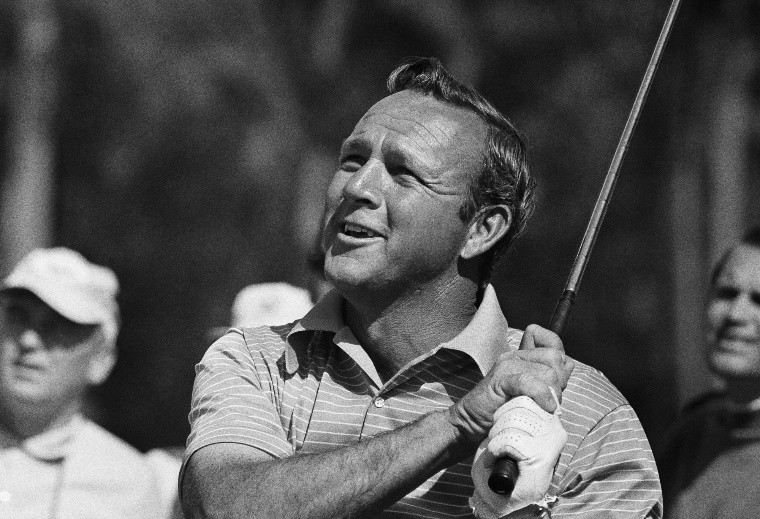
Arnold Daniel Palmer, born on September 10, 1929, in Latrobe, Westmoreland County, Pennsylvania, was more than a sports icon—he was a cultural phenomenon who transformed golf from an elite pastime into a sport embraced by the masses. Known affectionately as “The King,” Palmer’s charisma, competitive spirit, and humility made him one of the most beloved athletes in history.
Palmer was the eldest of four children born to Milfred Jerome “Deacon” Palmer and Doris Morrison Palmer. His father, Deacon, was the superintendent and golf professional at Latrobe Country Club, where the family lived in staff housing. Deacon’s role at the club gave young Arnold early exposure to the game, and he received his first set of clubs at the age of three. Despite the club’s policy of restricting play to members, Palmer would sneak onto the course to practice, often under the cover of darkness with his mother.
Growing up in the blue-collar steel town of Latrobe, Palmer developed a strong work ethic and a deep appreciation for discipline and perseverance—values instilled by his parents. His father’s tough-love coaching style and his mother’s quiet support shaped Palmer’s character and fueled his ambition.
Palmer’s talent on the golf course earned him a scholarship to Wake Forest College in North Carolina. There, he formed a close friendship with Bud Worsham, whose brother Lew was a professional golfer. The tragic death of Worsham in a car accident during Palmer’s senior year deeply affected him, prompting him to leave college and enlist in the U.S. Coast Guard. From 1951 to 1954, Palmer served with distinction, even designing a nine-hole pitch-and-putt course during basic training in Cape May, New Jersey. His time in the military helped refine his skills and solidify his commitment to golf.
Palmer’s breakthrough came in 1954 when he won the U.S. Amateur Championship in Detroit, Michigan. That victory convinced him to turn professional, and he quickly made his mark. In 1955, he won the Canadian Open, and by 1958, he had captured his first Masters title. Over the next six years, Palmer won the Masters tournament four more times and added victories at the British Open and U.S. Open to his resume. Between 1960 and 1963 alone, he claimed 29 professional titles, thereby earning the Associated Press’s “Athlete of the Decade” honor.
Palmer’s aggressive style of play and magnetic personality drew legions of fans, dubbed “Arnie’s Army,” who followed him with fervor. As golf entered the television era, Palmer became its first true superstar, helping to democratize the sport and expand its global reach. Over the span of his professional golfing career, he won 95 different tournaments and in 1974 was inducted into the World Golf Hall of Fame as one of the 13 original athletes honored.
In December 1954, shortly after turning professional, Palmer married Winifred “Winnie” Walzer, whom he had met at an amateur tournament. The couple shared a deep bond and were married for 45 years until Winnie’s death on November 20, 1999. Together, they had two daughters: Peggy and Amy. Palmer’s devotion to his family was evident throughout his life, and he often credited Winnie with being his emotional anchor during the highs and lows of his career.
In 2005, Palmer remarried, tying the knot with Kathleen “Kit” Gawthrop who was ten years younger than Arnold. Though less publicly visible than Winnie, Kit remained a supportive presence in Palmer’s later years.
Beyond golf, Palmer was a committed Freemason, following in the footsteps of his father who was also a Mason. Arnold was raised to the Sublime Degree of Master Mason at Loyalhanna Lodge #275 in Latrobe, Pennsylvania and remained active in the fraternity for many years. In 1997, he was Coronated with the prestigious 33° Scottish Rite honor by the Supreme Council in the Northern Masonic Jurisdiction, a testament to his dedication, philanthropy and contributions to the Masonic community.
Palmer’s Masonic values of integrity, charity, and brotherhood were reflected in his substantial philanthropic endeavors. He supported numerous causes, including children’s hospitals and educational initiatives, and helped establish the Arnold Palmer Hospital for Children in Orlando, Florida.
Arnold Palmer passed away on September 25, 2016, at the age of 87 in Pittsburgh, Pennsylvania. His ashes were scattered at Latrobe Country Club, the place where his journey began. At the time of his death, Palmer was worth an estimated $875 million, a reflection of his success not only in golf but also in business and branding.
Palmer’s legacy endures through his contributions to the sport, his charitable work, and the countless lives he touched. He was awarded the Presidential Medal of Freedom in 2004 and the Congressional Gold Medal in 2012, becoming one of the few athletes to receive both honors.
Arnold Palmer was more than a golfer—he was a pioneer, a philanthropist, a gentleman and a Scottish Rite Mason. His life story is a testament to the power of passion, perseverance, and purpose.
 Valley of Orlando eNews