By Den Ardinger 32° KCCH
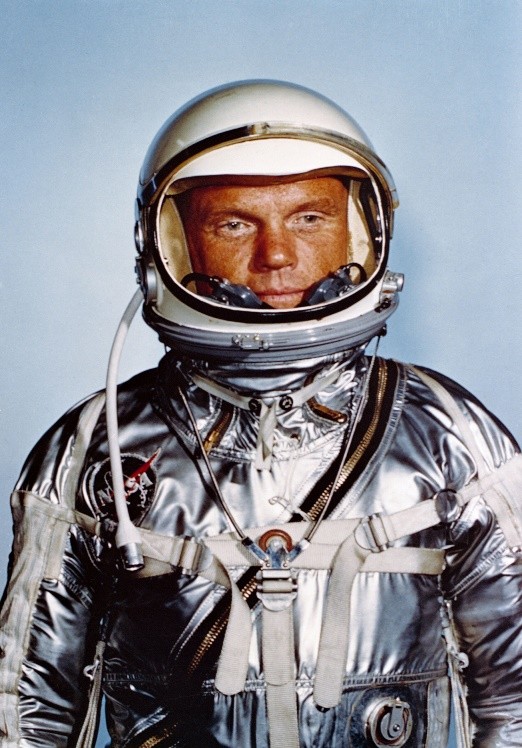
John Herschel Glenn Jr. was born in Cambridge, Ohio on July 18, 1921, and raised in the nearby town of New Concord. He was the son of John H. Glenn Sr. and his wife, Clara Theresa Sproat. His father was a plumber, and he helped his father run a rooming house for college students in New Concord. From an early age, Glenn exhibited a deep fascination with aviation and science, which would shape his extraordinary life as a combat pilot, astronaut, and U.S. Senator.
Glenn attended Muskingum College where he studied engineering. He married his childhood sweetheart, Anna Margaret Castor on April 6, 1943. His marriage and education were interrupted by World War II. He enlisted in the U.S. Marine Corps in 1943 and became a fighter pilot, flying 59 combat missions in the South Pacific. During the Korean War, he flew another 90 missions, earning the nickname “Magnet Ass” for his uncanny ability to attract enemy fire and survive. His military service earned him numerous decorations, including the Distinguished Flying Cross being awarded six times along with eighteen Air Medals.
After the war, Glenn became a test pilot and in 1957 made the first supersonic transcontinental flight across the United States, flying from California to New York in under four hours. This feat brought him national attention and helped secure his place among the original seven astronauts selected for NASA’s Project Mercury.
On February 20, 1962, Glenn made history aboard Friendship 7, becoming the first American astronaut to orbit the Earth. He circled the globe three times in just under five hours, a mission that not only marked a milestone in the space race but also made Glenn a national hero. His calm demeanor and technical skill during the flight earned him widespread admiration and solidified his legacy as a pioneer of space exploration. For this achievement he was awarded NASA’s Distinguished Service Medal. He retired from the U. S. Marine Corps at the rank of Colonel on January 4, 1965. He was inducted into the U. S. Astronaut Hall of Fame in 1990.
Following his retirement from NASA and the Marine Corps, Glenn entered politics. He was elected to the U.S. Senate from Ohio in 1974 and served four consecutive six-year terms until 1999. As a senator, Glenn focused on issues related to science, technology, and national defense. He was known for his integrity, bipartisan approach, and dedication to public service.
In a remarkable return to space, Glenn flew aboard the Space Shuttle Discovery in 1998 at the age of 77, becoming the oldest person ever to travel in space. His participation in the STS-95 mission was aimed at studying the effects of spaceflight on aging, and it symbolized the enduring spirit of exploration that defined his life.
Beyond his public achievements, Glenn was also a Freemason, a fact that was deeply meaningful to him. He began his life in Freemasonry in 1964 after being elected to receive the degrees in Concord Lodge #688 in New Concord, Ohio. He was also affiliated with DeMolay International, a Masonic youth organization. However, due to scheduling conflicts, he was not raised for 14 years at which time he was raised in a special “Mason at Sight” ceremony by Grand Master of Ohio, Jerry C. Rasor, on August 18, 1978. He later joined the Scottish Rite and was coronated a 33° Inspector General Honorary. Freemasonry’s emphasis on personal integrity, service, and lifelong learning resonated with Glenn’s values. His Masonic ties placed him among a distinguished group of astronauts who were also Freemasons, including Buzz Aldrin and Gordon Cooper.
Throughout his life, Glenn received numerous honors, including the Presidential Medal of Freedom, the nation’s highest civilian honor, awarded by President Barack Obama in 2012. He was awarded numerous honorary degrees from universities, and he also lent his name to institutions such as the John Glenn College of Public Affairs at Ohio State University, reflecting his commitment to civic engagement and education.
John Glenn passed away on December 8, 2016, at the age of 95 and having been married 73 years. His lifelong wife, Annie, passed in 2020 at the age of 100. John Glenn’s legacy endures not only in the annals of space exploration and American politics but also in the values he championed—courage, curiosity, and service to others. Whether soaring through the stratosphere or walking the halls of Congress, Glenn remained a steadfast advocate for technological progress and bipartisan unity.
Senator John H. Glenn, more than a man, a Scottish Rite Mason.
 Valley of Orlando eNews