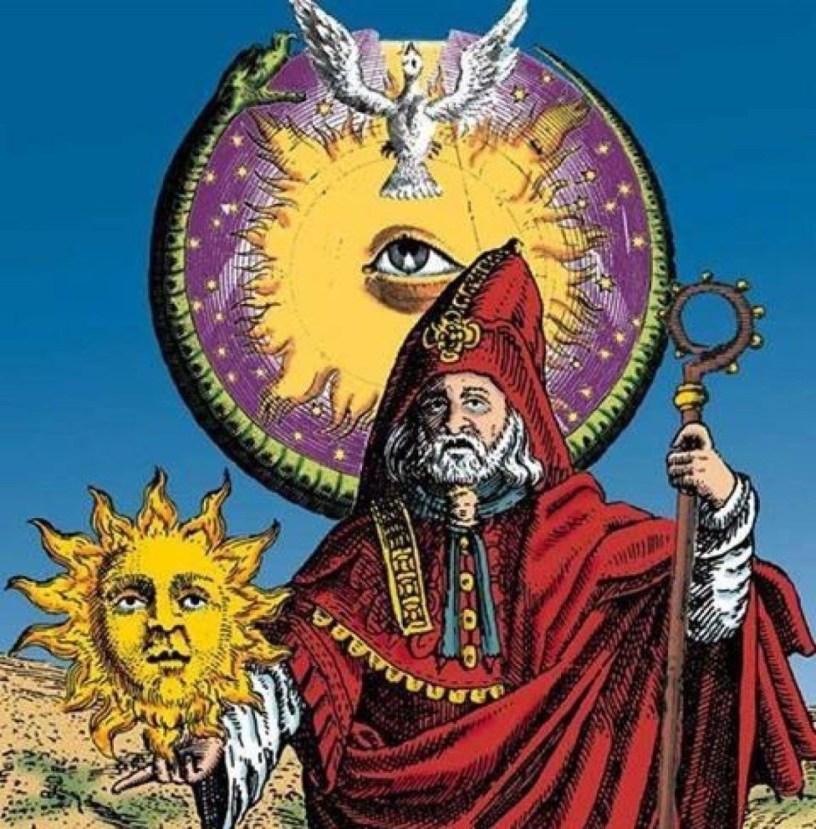
By Den Ardinger 32° KCCH
Hermes Trismegistus, known as “Hermes Three Times Great” or “Thrice-Greatest”, was a legendary figure in ancient Egypt and Greece. His knowledge and wisdom in many categories, such as alchemy, astrology, medicine, mathematics, science, and spirituality, separated him from all others of his age. Teachings of the ancient Greeks considered him a combination of the Greek god Hermes and the Egyptian god Thoth. The exact period of time he lived is uncertain and his legend may have been a composite of several figures who existed thousands of years before the current era. During the Renaissance period, for example, Hermes was believed to have been a contemporary of Moses, yet the teachings appear to be much older than that. Modern scholars are undecided on the dating of Hermetic principles preserved in ancient texts although the dating ranges from before the Great Flood to the beginning of the Christian era.
Regardless of the exact period when he lived, Hermes is recorded as having advanced knowledge of both the material and spiritual worlds and his philosophy has come to us through “Hermetic writings” generally under the topic of Hermeticism. This very ancient philosophy has come through prophets of multiple religious faiths and is considered “a single and true theology”.
Hermes is attributed to being the author of “The Emerald Tablet”. The origin of the wisdom of the thirteen sentences on the sacred tablet is believed to have come from Hermes. The tablet was found by Alexander the Great in a grave near Hebron. History has it that the tablet had been taken from Hermes dead hands by Sarah, the wife of Abraham, and was written in Phoenician. Recorded on the tablet is paraphrased, “As above, so below” upon which much in Freemasonry is built. His teachings included the unity of all things and his philosophy of pursuing spirituality in life.
Hermes’ original writings have mostly been lost through time. What exists today are fragments of his wisdom preserved in many ancient texts. These are mostly written in Greek, Latin, or Arabic. Much is thought to have been lost during the burning of the Library of Alexandria in Egypt. What could be gathered during the Renaissance was studied intently and incorporated into mystery schools. This insight led to the birth of science as we have it today but with the separation of “hard science” as we have it now and “religion”. Because of the difficulty of reading and understanding the ancient scripts, there are few scholars today able to carry on original research. Nevertheless, Hermeticism is universally considered to have great value and is still studied today while the search for more ancient fragments continues.
Over thousands of years, the Hermetic philosophy has been passed down to us and has had a strong influence on Western thought. Books have been written exploring Hermes’ ideas such as Manly P. Hall’s book, “The Life and Teachings of Hermes Trismegistus” among others and his topics have been discussed in Albert Pike’s work, “Esoterika” in the Scottish Rite. With Pike, Hermes was considered “The Master of the Lodge” in Freemasonry.
Hermes, more than a great man, a thinker.
 Valley of Orlando eNews