By Den Ardinger 32° KCCH
Pythagoras of Samos, commonly known as simply Pythagoras, was born on the Greek island of Samos in the Aegean Sea about 570 BCE. He was the son of a wealthy gem engraver, Mnesarchus, and his wife, Pythais, both natives of Samos. As he grew up, it is believed he travelled to the Near East, and to Egypt, and this is where he was educated. It has been said that he learned to speak Egyptian from Pharaoh Amasis II and studied with the Egyptian priests at Thebes which was exceptional for a foreigner. It was here that he learned geometry. Some ancient writers record that he travelled to Persia and was taught by the Magi there including Zoroaster himself in addition to travelling in India. Sources and claims are many, and often contradict each other.
About 530 BCE, Pythagoras left Greece and went to Croton in southern Italy. There he founded a mystery school of great renown. Those admitted lived in the commune, were vegetarians, and were sworn to secrecy with their learning and discoveries kept tightly guarded. The teachings of this school are not entirely certain but reliable sources, such as Aristotle, talk of their philosophy. Among their beliefs was “Metempsychosis” which says that all souls are immortal and that, after death, a soul takes on a new body and continues. Another belief was in the “Harmony of the Spheres” stating that the planets and stars moved according to precise mathematical equations which can be put to music as in a symphony in the heavens.
Mysticism was a key area of study in the school and Pythagoras was said to have been the first to practice and teach divination. The study of prophecy, by using numbers, was also included. Numerology was taught for mystical purposes and the study of mathematics, particularly arithmetic as we have it today, originated at this time.
For centuries, Pythagoras has been credited with discoveries in numerous fields, particularly mathematics and science. Included among his greatest achievements are determining that the Earth is a sphere, the Pythagorean Theorem, investigating the five regular solids, and the Theory of Proportions. As an astronomer, he determined that the planet Venus was the morning star and also the evening star, which until then had been considered separate bodies.
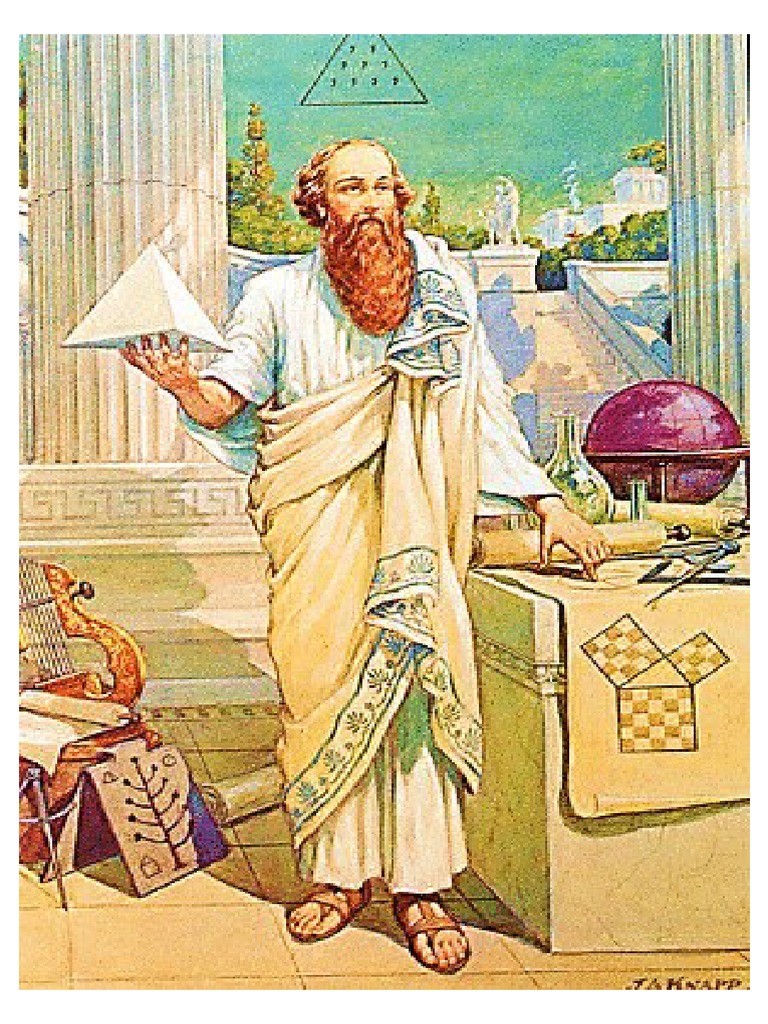
The Pythagorean Theorem was known before his time by mathematicians in Babylon and India, but he is thought to have introduced it to the Greeks. This theorem states that, using a right triangle, the sum of the areas of the two squares equals the square of the third which is the hypotenuse (i.e. the famous “a” squared plus “b” squared equals “c” squared).
Pythagoras died about 495 BCE either in Groton or Metapontum at the age of 75. Although the writings of many historians contradict each other, there is one common thread in all of them and that is that Pythagoras was considered a very learned man who was a legend even during his lifetime. He was often called a “polymath” because he was knowledgeable in so many fields. The teachings of his mystery school were preserved by the initiates and passed down through time from one secret society to another. Embedded within Freemasonry is the essence of his philosophy. The influence of Pythagoras was significant in antiquity and continues to this very day.
Pythagoras, more than a great man, a thinker.
 Valley of Orlando eNews