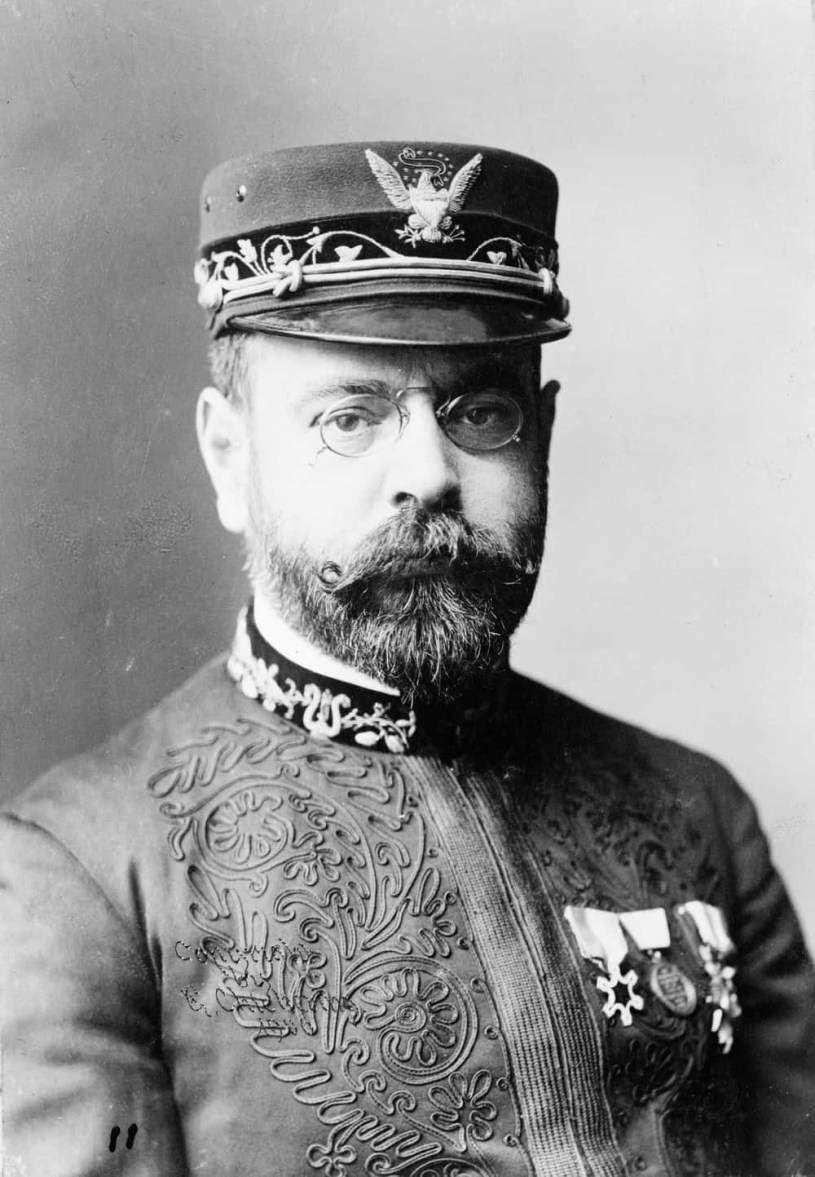
By Den Ardinger 32° KCCH
John Philip Sousa was born in Washington, D.C. on November 6, 1854. He was the third of ten children to Joao Antonio de Sousa (1824-1992) and Maria Elisabeth Trinkhaus (1826-1908). He loved music from an early age and by the time he was six in 1861 he was studying the violin, piano, the flute, and a variety of brass instruments while also developing his singing voice. His father played the trombone in the Marine Band and enlisted his son in the United States Marine Corps as an apprentice at the age of 13 in 1867 with the rank of “boy”. Here he studied until being discharged in 1875 at the age of 21.
Once discharged, he concentrated on playing the violin and joined a theatrical group where he learned to conduct. In December 1879 he married Jane van Middlesworth Bellis (1862-1944) with whom he had three children. In 1880, Sousa returned to the Marine Corps Band and remained as its conductor until 1892. During this time, he led “The President’s Own” band and played under five presidents and at the inaugural balls of James A. Garfield in 1881 and Benjamin Harrison in 1889.
On July 15, 1881, John Philip Sousa became initiated in Hiram Lodge No. 10 (now Hiram-Takoma Lodge No. 10) in Washington, D.C. He was an active member there for the remainder of his life. He was named the Honorary Band Leader of the Temple Band of Almas Shriners, the DC-based Chapter of Shriners International. Among his many famous compositions was the “Nobles of the Mystic Shrine” March in 1923.
In addition to composing and conducting, he worked with Philadelphia instrument maker J. W. Pepper to invent and perfect the “Sousaphone” which was a modified tuba instrument that projected the music upward and over the band whether it was being played while sitting or marching. It was perfected by 1898 and was his preferred instrument.
After leaving the Marine Band in 1892, he created The Sousa Band and toured widely until 1932 performing at 15,623 concerts all around the world. He was a prolific composer and wrote more than 130 marches, 15 operettas, 5 overtures, 11 suites, 24 dances, 28 fantasies, and countless other works. Among his most famous marches is “Semper Fidelis” written in 1909 which is the official march of the United States Marine Corps, and “The Stars and Stripes Forever” which is the official march of the United States.
As the United States entered World War I in 1917, he was commissioned a lieutenant in the Naval Reserve. He was 62 years old, which was the mandatory retirement age for Naval officers. He donated all but $1.00 of his salary to the Sailors’ and Marines’ Relief Fund. During the war he led the Navy Band at the Great Lakes Naval Station near Chicago. At the end of the war in 1918, he returned to leading his own band. He was later promoted to lieutenant commander but did not return to active duty.
In his later years he lived in Sands Point, New York. He died in Reading, Pennsylvania of heart failure on March 6, 1932, where he had been practicing a rehearsal of “Stars and Stripes Forever” as a guest conductor of the Ringgold Band. He is buried in Congressional Cemetery in Washington, D.C. Every year on November 6th, the Marine Band performs “Semper Fidelis” at Sousa’s grave.
Among his many honors include a 2-cent postage stamp with his image in 1940 and the Liberty Ship SS John Philip Sousa named in his honor. The Marine Band has the ship’s bell and plays it during performances of the “Liberty Bell March”. In 1952, the movie “Stars and Stripes Forever” was made by 20th Century Fox about his life. In 1987, Congress named “The Stars and Stripes Forever” as the national march of the United States.
John Philip Sousa, more than a man, a Mason.
 Valley of Orlando eNews