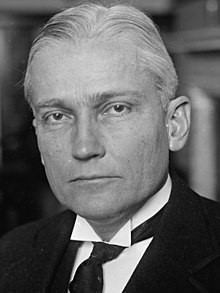
By Den Ardinger 32° KCCH
I returned this week from exploring Machu Picchu, Peru; one of the Seven Wonders of the World. While climbing the steep steps among the ruins in the mountainous terrain, I couldn’t help but wonder how it was found after being covered with centuries of jungle growth. My curiosity was piqued, and research uncovered that these ruins were brought to the world’s attention by a Masonic brother…Hiram Bingham…in 1911.
Hiram Bingham (1875-1956) was born in Honolulu, Hawaii on November 19, 1875. He was the son of Protestant missionaries to the Kingdom of Hawaii; Clara Brewster and Hiram Bingham II. In his early years he attended school in Hawaii but returned to New England to pursue higher education in his teens. His family had deep roots in Massachusetts going back to the Mayflower passenger, William Brewster. He graduated from Phillips Academy in Andover in 1894 and earned a Bachelor of Arts degree from Yale College in 1898. He then went to the University of California at Berkeley and earned a Master of Arts degree. In 1905 he obtained his doctorate from Harvard University.
Bingham was a member of Hiram Lodge Number 1 of New Haven, Connecticut and was also a member of the Acacia Fraternity, a college fraternity affiliated with Freemasonry.
In 1900, Bingham married Alfreda Mitchell, the granddaughter of Charles L. Tiffany and his wife. Hiram and Alfreda had seven sons with several of them becoming quite accomplished. Hiram and Alfreda later divorced, and he married Suzanne Carroll Hill in June 1937.
There was little academic interest in South America in the early 1900s, but he took the few courses on the subject that were offered. With this in his background, and with a focus on the topic, he was appointed a lecturer on South American history at Yale in 1907. In 1908, he was a delegate to the First Pan American Scientific Congress at Santiago, Chile. While returning home, he traveled extensively through South America and wrote an account of his trip which included the pre-Columbian city of Choquequirao.
Bingham was not an archaeologist, but he was excited by the idea of exploring lost Inca cities. In 1911 he organized the Yale Peruvian Expedition with the intention of finding the lost capital of the Inca empire. Using local guides, he discovered Vitcos (then called Rosaspata) and Vilcabamba (then called Espiritu Pampa). Continuing on, he found Machu Picchu and identified it as the Lost City of the Incas. Research later confirmed that the last capital of the Incas had been Vilcabamba.
Machu Picchu, now a World Heritage Site, had been largely forgotten up to that time. When Bingham found it in the steep mountainous jungle, it was inhabited by only a handful of people. When he asked upon starting out if there were snakes in the jungle. He was told that, no, but there was jungle among the snakes. A few other explorers had been to Machu Picchu in the years before him, but Bingham is credited with bringing the important find to the attention of the world.
Continuing his explorations, Bingham returned to Peru in 1912, 1914, and 1915 with the aid of Yale University and the National Geographic Society. Additional research determined that Machu Picchu was a Royal Estate where the Inca rulers spent their summer months. Its true age and importance are controversial since it seems that later Inca builders built upon much older earlier structures with origins lost in dim antiquity. When the Inca people were asked who built these magnificent ruins, their reply was simply, “Our ancestors.” In 1948, Bingham wrote the best-selling book, “Lost City of the Incas” that detailed his travels. With this publication, he is believed to have become the Indiana Jones of the archaeological world and the basis for the movies with Harrison Ford.
As World War I was being fought in Europe, he joined the Connecticut National Guard and was a Captain by 1916. He became an aviator in 1917 and organized the United States Schools of Military Aeronautics. This organization of eight universities provided aviation training for cadets. He served in the Aviation Section of the United States Signal Corps and was promoted to Lieutenant Colonel. After the U.S. entered the fighting in 1917, he deployed to France and commanded the Third Aviation Instruction Center. After the war ended, he published his experiences as “An Explorer in the Air Service” in 1920.
He was elected Lieutenant Governor of Connecticut and served until 1924 at which time he was elected Governor of Connecticut. With a twist of fate, he was also elected to be a Senator to fill a Senate vacancy. Being now a Senator-elect and Governor-elect, he chose the Senator position after serving one day as Governor from January 7th to January 8th, 1925. This is the shortest of any Connecticut Governor. He was reelected as a Senator in 1926 for six more years.
During World War II, he lectured at United States Naval training schools. After the war he served as the Chairman of the Civil Service Commission Loyalty Review Board until 1953.
Hiram Bingham died at the age of 80 at his home in Washington, D.C. on June 6, 1956. He was buried in Arlington National Cemetery in Virginia. As my wife, Andrea, and I boarded a bus and travelled the Hiram Bingham Highway to take us to the Hiram Bingham Train with his name in large gold letters on every car to return to Cusco to continue our adventure, I couldn’t help but accept that Dr. Hiram Bingham was more than a man; he was a Mason.
 Valley of Orlando eNews