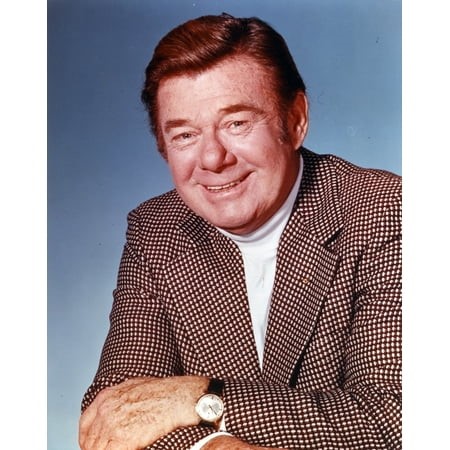
By Den Ardinger 32° KCCH
Arthur Morton Leo Godfrey (1903-1983) was born August 31, 1903, in Manhattan, New York. He was the son of Arthur Hanbury Godfrey, a sportswriter, and his wife, Kathryn Morton. He was the eldest of five children. When he was 12, the family moved to Hasbrouck Heights, New Jersey. He did not do well in high school and dropped out after a year. He left home and by the age of 15 was working as a typist at Camp Merritt, New Jersey. The United States had entered World War I and his administrative skills were badly needed.
He enlisted in the U.S. Navy two years later by lying about his age. He served from 1920 to 1924 as a radio operator on naval destroyers. It was here that his lifelong interest in radio, both professionally and as a ham radio operator with call sign K4LIB, began. He later joined the Coast Guard and served from 1927 to 1930. Here he obtained additional advanced training at the Naval Research Laboratory. Dabbling in broadcasting, he started to build a small following while hosting a weekly radio program. This led, after being discharged from the Coast Guard, to becoming a radio announcer for Baltimore station WFBR.
Godfrey developed his own style of announcing. He offered a distinct alternative to the formal style of the times and focused, instead, on speaking directly to the audience in a more casual manner. His wisecracks and jokes were widely enjoyed, and his reputation gradually spread across the airwaves. He was more than an announcer. He was an entertainer, and he sang and played the ukulele. By 1934 he was a freelance entertainer and shortly afterwards had a daily variety show where he interviewed guests, sang, played records, and commented on the commercials which was unheard of at the time such as when he discussed Bayer Aspirin as bare ass prin. In 1937 he hosted the first successful quiz program called “Professor Quiz”.
Arthur Godfrey became a Master Mason in 1937. He was a member of Acacia Lodge Number 18 in Washington, D.C.
On February 24, 1938, he married, as his second wife, Mary Bourke. They had two children and divorced in 1982 just before his death. He had been married earlier to Catherine Godfrey and had a daughter by her.
As World War II approached, he wanted to remain connected to the Navy but because of a hip injury from a car crash, knew he could not be reenlisted as before. He had connections to President Roosevelt who helped him get commissioned in the Naval Reserve before the U.S. entered the fighting in 1941. This allowed him to participate in exercises around Washington, DC.
Godfrey became nationally known in April 1945 when he gave a live, firsthand account of President Roosevelt’s funeral procession. The entire CBS network broadcast his heartfelt personal report and the emotional response moved across the nation as a wave.
Becoming nationally known, CBS gave him his own, unscripted, variety program called “Arthur Godfrey Time” that was broadcast Monday through Friday until 1972.
From time to time, he had a hit recording. These started with “Too Fat Polka” and “What is a Boy?” followed by “What is a Girl?” between 1947 and 1952. His programming expanded into prime time with “Arthur Godfrey’s Talent Scouts”. Godfrey successfully made the transition from radio to television and for a time his programming was simultaneously broadcast on both. He had loyal sponsors including Lipton Tea, Frigidaire, Pillsbury cake mixes, and Chesterfield cigarettes. By 1959, his advertising billings were at $150 million, which was the highest in the industry and double those of his competitor, Ed Sullivan.
Godfrey had a decades long interest in flying which included gliders and aircraft. Although he did not fly in combat in World War II, he did manage to have the Navy qualify him as a Naval Aviator since he was in the Naval Reserve. He later transferred to the Air Force Reserve and at one point in the 1950s had flown every active aircraft in the military inventory.
Although Arthur Godfrey was widely popular across America, his popularity was diminished when, at times, he had disputes with his staff. First among these disputes was when he fired singer Julius La Rosa on the air in the fall of 1953. In the following two years, he fired twenty others and his popularity, although still strong, was never quite the same again.
In addition to radio and television, he appeared in three films, “4 for Texas” in 1963, “The Glass Bottom Boat” in 1966, and “Where Angels Go, Trouble Follows” in 1968.
After retirement, he occasionally made guest appearances on television shows. He was even going to host a show where he reconciled with Julius La Rosa, but an agreement could not be reached. In time, his emphysema became worse. It was caused by decades of smoking and radiation treatment for lung cancer. He died in Mount Sinai Hospital in Manhattan on March 16, 1983 at the age of 79. He was buried in Union Cemetery in Leesburg, Virginia.
His achievements won him many honors over the years. He received the NBAA Meritorious Service to Aviation Award in 1950. He was inducted into the National Association of Broadcasters Hall of Fame and in 1987, into the Aviation Hall of Fame and the Radio Hall of Fame in 1988. He earned the Peabody Award in 1971 and has three stars on the Hollywood Walk of Fame. In 2001, he was inducted into the Ukulele Hall of Fame. He is listed among the 25 greatest radio and 25 greatest television talk show hosts of all time.
Arthur Godfrey, more than a man, a Mason.
 Valley of Orlando eNews