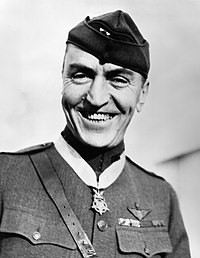
By Den Ardinger 32° KCCH
Edward Vernon ‘Eddie’ Rickenbacker (originally Richenbacher) (1890-1973) was bornOctober 8, 1890,in Columbus, Ohio. He was a son of Liesl Basler and her husband, Wilhelm Richenbacher. He was the third of eight children in the family. The entire family worked to make ends meet and he worked before and after school. He had several close calls with death as a child and once pedaled a bicycle attached to an umbrella off a barn roof to see if he could fly.
His father died when Eddie was 13 and he was forced to drop out of seventh grade to take full time work to help support the family. He worked for the Oscar Lear Automobile Company in 1905 and took an engineering course from the International Correspondence School. The chief engineer helped direct his learning and took him with him as a mechanic to the 1906 Vanderbilt Cup Race. He changed jobs frequently and became the chief testing engineer of the Columbus Buggy Company where he impressed his employer, Harvey S. Firestone. Under Firestone’s direction, he traveled widely at the age of 18 as an engineering problem solver and experimenter.
He excelled at auto racing and competed frequently as part of a mechanical crew or driver. He took part in the first Indianapolis 500 as a relief driver. In 1913, he won three races and finished 27th in the American Automobile Association’s ratings. In the years to come, he continued to win and soon became a national racing figure making $40,000 a year.
He went to England to develop a new race car and with his name then spelled “Richenbacher” he was questioned and tailed by Scotland Yard as a potential spy since Britain was then involved in World War I. While there, he became interested in aviation after watching British aircraft flying over London. Once back in the United States, he proposed an aero squadron to the New York Times made up of mechanics and race car drivers. He was already friends with Glenn Martin, founder of Glenn L. Martin Company, and Major Townsend Dodd who became General John Pershing’s aviation officer. After the United States entered the war in April 1917, he went to Washington, DC to push his idea further.
General Pershing invited him to sail with him to England and he enlisted in the infantry in France in mid-June. He then took flight lessons to become a fighter pilot and had 25 hours in the air by September. By January 1918, he was enrolled in gunnery school and by March Lieutenant Rickenbacker and other officers made up the 1st Pursuit Squadron. Here he was taught by the French flying ace, Major Raoul Lufbery.
He made his first combat sortie on April 13, 1918, but became lost in the fog and was forced to land. On April 29th, he shot down his first enemy aircraft and by May 28th he was an ace with five victories. He was awarded the French Croix de Guerre that month. By September he was named commander of the American 94th Hat-in-the-Ring Squadron, being chosen over several other senior captains. Taking command, he immediately built the group into a close-knit team. He made solo patrols, shot down more enemy aircraft, and was awarded the Medal of Honor by President Herbert Hoover in 1931 for his two victories over Billy, France. His goal was to shoot down the enemy’s observation balloons even though they were heavily defended. He devised tactics and put them into practice. He soon had more hours in the air than any other, 300. By the end of the war in November he had the highest number of American air victories with 26. When the war ended at 11 am on November 11, 1918, he flew above No Man’s Land to verify the cease fire. He later quipped that he was the only person to observe the grand celebration on both sides.
For his efforts he was awarded the Distinguished Service Cross a record eight times with one later upgraded to the Medal of Honor. He also was awarded the Legion of Honor and the Croix de Guerre from France. He returned to America as one of its most notable war heroes. He was promoted to Major but turned the promotion down saying it was not earned. For the rest of his life, he was referred to as Captain. He toured the country to promote Liberty Bonds, made a speaking tour, and signed a contract for his memoir, “Fighting the Flying Circus”. He was discharged in November 1919.
He turned his interests to aviation and to improving safety and the public’s confidence in air transportation. He made four crossings of the continent and during these trips he had seven crashes, nine near misses, and eight forced landings.
Rickenbacker then started the Rickenbacker Motor Company with a group of partners. He emphasized engineering and focused on lowering vibration and improving brakes. Competition was great and the company eventually went bankrupt after Eddie resigned and the chief engineer died.
In September 1922 he married Adelaide Frost Durant in South Beach, Connecticut. They later adopted two sons.
In 1926, he founded Florida Airways. One of his investors was Henry Ford. The company carried mail and passengers between Miami and Jacksonville but failed within a year when Tampa did not construct an airport as agreed.
In 1927, he purchased the Indianapolis Motor Speedway and for years afterwards he drove the race’s pace car. He operated the Speedway for more than ten years, then closed it in 1941 to save resources for the war effort. He sold the Speedway in 1945.
Rickenbacker founded Eastern Airlines with a merger of Eastern Air Transport and Florida Airways. He became the general manager in 1935 and in 1938 purchased the company for $3.5 million dollars. He then built the company into a major airline with bigger and better aircraft. Before America entered World War II, he voiced strong support for Britain. He rallied World War I veterans to support Britain and used Eastern Airlines equipment to fly needed items to Europe.
In February 1941, Rickenbacker was a passenger on an Eastern Airlines flight that crashed outside of Atlanta, Georgia. During the crash he was badly injured and was soaked in fuel. Everyone was forced to spend the night at the crash site. The newspapers had already declared him dead when they were recovered the next day because his injuries were so severe. Medical teams left him unattended so the doctors could work on those “that could be saved”. Much to the astonishment of some, he survived.
In October 1942, he was making a tour of air bases in the Pacific Theater using a B-17G bomber when they ran out of fuel and had to ditch in the ocean due to faulty navigation equipment. For 24 days the crew, many injured, drifted in a life raft. Their food ran out after three days and they lived by catching small fish and rainwater. Once again, the newspapers were reporting him dead, and the search effort was going to be discontinued until his wife convinced the Navy to look for one more week. During that week they were found, and the survivors were picked up. During the ordeal, he lost over 40 pounds. He later wrote a book about their experiences.
He continued supporting the war effort for the duration and this included making trips abroad. He toured Soviet airplane factories and gave advice on how to use the equipment they were receiving from the United States.
Rickenbaker was raised a Master Mason in Kilwinning Lodge No. 297, in Detroit, Michigan in 1922. In 1942 he was coronated a 33° Inspector General Honorary in the Scottish Rite. He was also awarded the Distinguished Achievement Medal by the Grand Lodge of New York.
In his later years he and his wife traveled widely. He frequently gave motivational speeches. He died of pneumonia while traveling in Zurich, Switzerland at the age of 82 on July 23, 1973. He is buried in Green Lawn Cemetery in Columbus, Ohio. His wife died in 1977.
Eddie Rickenbacker, more than a man, a 33° Scottish Rite Mason.
 Valley of Orlando eNews