By Den Ardinger 32° KCCH
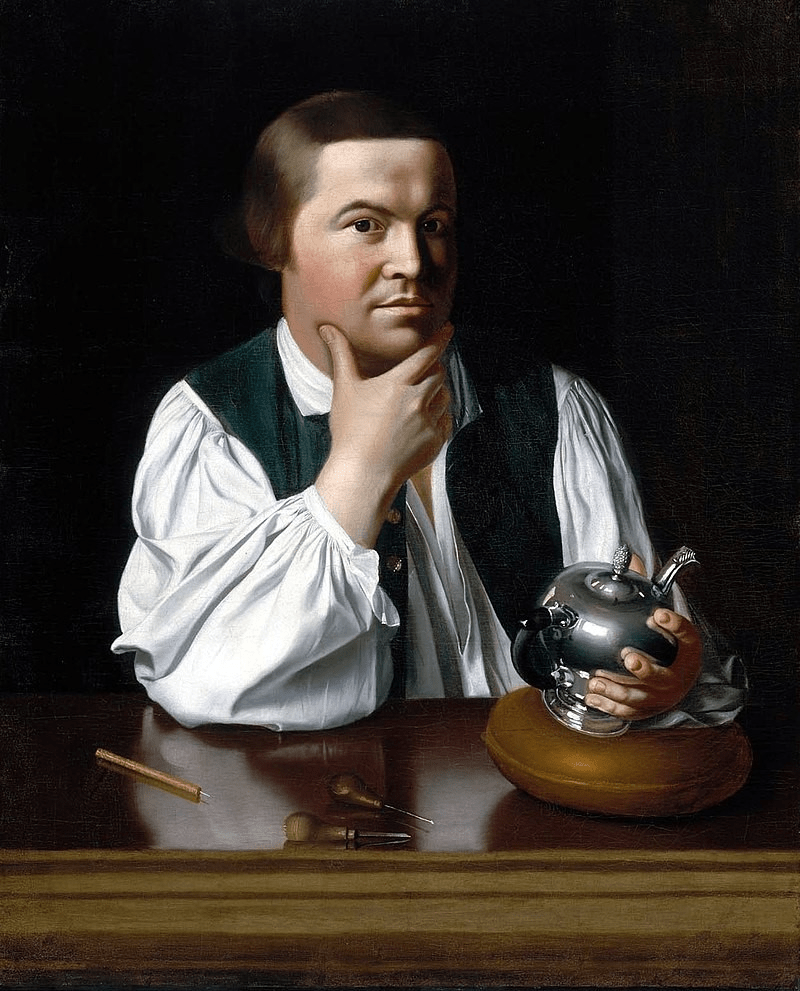
American Revolutionary War Patriot, Paul Revere, was born January 1, 1735 (modern calendar) in the North End of Boston, Massachusetts. He was the third of twelve children born to Apollos Rivoire and his wife, Deborah Hitchborn. His father Americanized his name to Paul Revere and set aside his French Huguenot heritage as he built his reputation as a silversmith. When young Paul was 13, he became an apprentice to his father and quickly learned the finer skills of a silversmith and engraver.
When his father died in 1754, young Paul was only 19 so he could not legally assume the family silver shop business. To bide his time until he could, he entered the military in February 1756 as a Lieutenant in a provincial artillery regiment. During part of the French and Indian War, which lasted from 1754 to 1763, he served at Fort William Henry on Lake George in New York which was then in the wilderness. He did not stay in the military long and returned to run the family silver business as soon as he was of the legal age of 21.
On August 4, 1757, he married Sarah Ome (1736-1773). They had eight children together but only one outlived the father.
Revere’s silver business had its ups and downs like any other at that time and at one point he was forced to use his fine tools as a dentist to make ends meet. He was taught dentistry by a local surgeon who was one of his many friends in the local community. He made many before the Revolutionary War began; some of which he met at his local lodge meetings where he had become a Freemason at the Lodge St. Andrews No. 81. The exact date he became a Mason is not known but it was between 1756 and 1769 at which time his name was recorded on the Grand Lodge of Scotland membership register. As the war fever began to brew, he joined the Sons of Liberty in 1765 along with many of his Masonic friends.
In 1770 he purchased the house in Boston’s North End which is now a museum to manage the space required by his growing family. However, his wife died in 1773. He then married Rachel Walker (1745-1813) and they had eight more children.
By 1773, the colonies were approaching fever pitch for war and tensions with the British were high. On December 13th, Revere was one of the leaders in the Boston Tea Party that dumped tea from the sailing vessel Dartmouth and two other ships into Boston Harbor to oppose the Tea Act England had passed. From December 1773 until November 1775, Revere served as a courier to the Committee of Public Safety that was then formed to sidestep duties of the regular government. His courier duties were closely monitored by British intelligence and his name even appeared in London newspapers.
In 1774, British General Thomas Gage closed Boston Harbor and disbanded the colonial provincial assembly. In December the colonists stormed the lightly guarded munition stores at Fort William Henry and seized the gunpower. From that point on, preparations became intense to prepare for war.
The highlight of Paul Revere’s fame came on the evening of April 18, 1775. British regulars were observed leaving their barracks and marching north to the towns of Lexington and Concord to seize gunpowder and war materials gathered there by the colonists. To warn the colonial militia, Paul Revere and William Dawes galloped through the night alerting a network of townsmen and other riders to the approaching force. The next day, the battles of Lexington and Concord signaled that the Revolutionary War was on.
It was this ride that Henry Wadsworth Longfellow wrote the famous poem about in 1861; forty-three years after Revere’s death. The poem begins:
Listen, my children, and you shall hear
Of the midnight ride of Paul Revere,
On the eighteenth of April, in Seventy-Five;
Hardly a man is now alive
Who remembers that famous day and year
In April 1776, Revere was commissioned a Major in the infantry in the Massachusetts militia. A month later he was promoted to Lieutenant Colonel and transferred to the artillery. As the war progressed, he was in several engagements and with the politics of arms being strongly held, he had his disagreements with others. However, in the end, his name was cleared, and his legend was secure.
In the years that followed, he moved from silversmithing to iron working. He also worked with bronze and cast cannons for the federal government. He had success casting large bells and some are still in use today. In the end, his innovations with standardizing production of stoves, ovens, and iron tools brought him financial success.
By 1795, Paul Revere was the Grand Master of the Grand Lodge of Massachusetts.
Paul Revere died May 10, 1818, at the age of 83. His oldest living son, Joseph Warren Revere, took over the business and it is still in operation today. He is buried in Granary Burying Ground on Tremont Street in Boston.
Paul Revere, more than a man, a Mason.
 Valley of Orlando eNews